Realize higher performance in applications such as infrared sensors and X-ray detectors with limited space
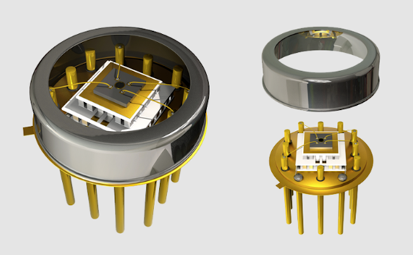
Tark Thermal Solutions, formerly known as Laird Thermal Systems, a leading global manufacturer of thermal management solutions, announced the launch of two-stage and three-stage OptoTEC ® The MSX series micro multi-stage thermoelectric cooler (TEC) is designed specifically for high-performance (COP) applications such as infrared sensors and X-ray detectors.
OptoTEC ® The MSX series can provide a temperature difference (Δ T) of up to 100-120 ° C in a vacuum environment, with a micro cold side footprint as small as 2.0 x 4.0mm and an overall height as low as 3.3mm (two-stage) and 3.8mm (three-stage).
The MSX series is built using next-generation advanced thermoelectric materials, high-temperature solder, and proprietary automation technology. Compared to previous products, the cooling capacity has increased by 10%, enabling greater temperature differences in optical packaging with extremely limited space, while strictly maintaining system power consumption within budget. For manufacturers looking to accelerate design cycles and reduce integration risks, MSX is a seamless path into high value-added optical TEA. By directly integrating refrigerators into popular industry standard TO-39, TO-46, TO-66, and TO-8 optical packages, MSX Optical TEA helps accelerate time to market and improve product quality.
Main advantages in imaging applications
•Deep cooling to reduce thermal noise: Under vacuum low heat load, the MSX multi-stage cooler can keep the system temperature far below the ambient temperature of -60 to -80 ° C, significantly reducing thermal noise and improving signal-to-noise ratio (SNR) in demanding CCD imaging applications, ensuring clearer images and better low light performance in applications such as machine vision, satellite and astronomical imaging, and high-speed detection.
•Optimized for X-ray detectors: The MSX series typically operates stably at temperatures below -20 to -60 ° C without gas release to protect sensitive vacuum environments. This makes them very suitable for integration into instruments such as spectrometers, diffractometers, particle size analyzers, and portable XRF devices. By lowering the detector temperature, MSX can reduce leakage current and electronic noise, thereby achieving more accurate material identification and structural analysis in compact X-ray systems.
• Achieve more compact infrared design: Multi level MSX devices can control temperature between -20 to -80 ° C and can be integrated into compact mechanical packaging. The cold side occupying area can be as small as 2.0 × 4.0mm, with a low stacking height, and can be used for deep cooling of micro sized optical headers in applications such as national defense, gas detection, non-destructive testing, and security.
• Achieving high performance with small volume: Compared with standard TEC, the MSX series uses advanced thermoelectric materials and high filling rate P-type and N-type components, which increase cooling capacity by 10% while improving system performance. By combining solid-state architecture with low solder gap technology, thermal uniformity, mechanical integrity, and on-site reliability have been improved, achieving maintenance free temperature stability without gas release.
The MSX multi-stage platform of Tucker Thermal System and our integrated optical TEA enable design engineers to further push the limits of image quality while further reducing the system footprint. By combining deep stable refrigeration with TO based ultra small packaging, as well as internal automated assembly processes, Tucker thermal systems can minimize integration complexity and accelerate time to market, allowing our customers to focus on improving the performance of sensors and detectors. ”
- Andrew Dereka, Director of Thermal and Electrical Products at Tucker Thermal Systems
The Tucker Thermal System will showcase MSX and MSX Optical TEA at the "OFC 2026" event at the Los Angeles Convention Center in California from March 17 to 19, 2026. We welcome everyone to visit booth 5012 for exchange. We will also focus on the MBX series micro thermoelectric coolers used for temperature stabilization of EML and coherent lasers in high-density computing, as well as the high-temperature ETX series thermoelectric coolers used in autonomous systems, machine vision, and digital light processors.
To learn more about the MSX series, please visit: https://tark-solutions.com/cn/products/thermoelectric-cooler-modules/micro-MSX-series
Frequently Asked Questions and Answers
Question 1: Which imaging applications benefit the most from the MSX series?
Answer 1: MSX multi-stage TEC is highly suitable for high-end CCD cameras in applications such as machine vision, satellite and astronomical imaging, high-speed detection, as well as infrared sensors and X-ray detectors in analytical, industrial, and aerospace systems.
Question 2: How can MSX series refrigerators improve image quality?
Answer 2: By lowering the sensor temperature to 40-100 ° C below the ambient temperature and maintaining stable operation, the MSX multi-stage cooler can significantly reduce thermal noise, thereby improving signal-to-noise ratio, low light performance, and overall image resolution.
Question 3: Why is the MSX series very suitable for vacuum or sealed detector packaging?
Answer 3: The MSX cooler adopts solid-state thermoelectric technology, has no moving parts, is designed for vacuum operation, does not release gas, and helps protect the environment around sensitive X-ray and infrared detectors.
Question 4: How can the optical TEA of the Tucker thermal system using MSX refrigerators benefit OEMs?
Answer 4: The Tucker Thermal System integrates MSX refrigerators into widely used TO-39, TO-46, TO-66, and TO-8 optical packages, providing easy-to-use and simple plug-in optical TEA, simplifying mechanical design and assembly, shortening time to market, and improving manufacturing repeatability.
Question 5: How does MSX support compact instrument design?
Answer 5: The cold side footprint of the MSX device is as low as 2.0 × 4.0mm, and the overall height is very low. It provides deep cooling in the micro sized optical end, which can achieve smaller and lighter imaging instruments without sacrificing thermal performance.