Even with extremely small capacitors, it can operate stably
ROHM, a globally renowned semiconductor manufacturer headquartered in Kyoto, Japan, announced today that it has developed the Nano Cap, a 12V/24V system level 1 power supply for automotive devices, industrial equipment, communication infrastructure, and other applications, equipped with ROHM's proprietary ultra stable control technology ™”、 LDO regulator with an output current of 500mA * 2 IC "BD9xxN5 series" (18 products in total).
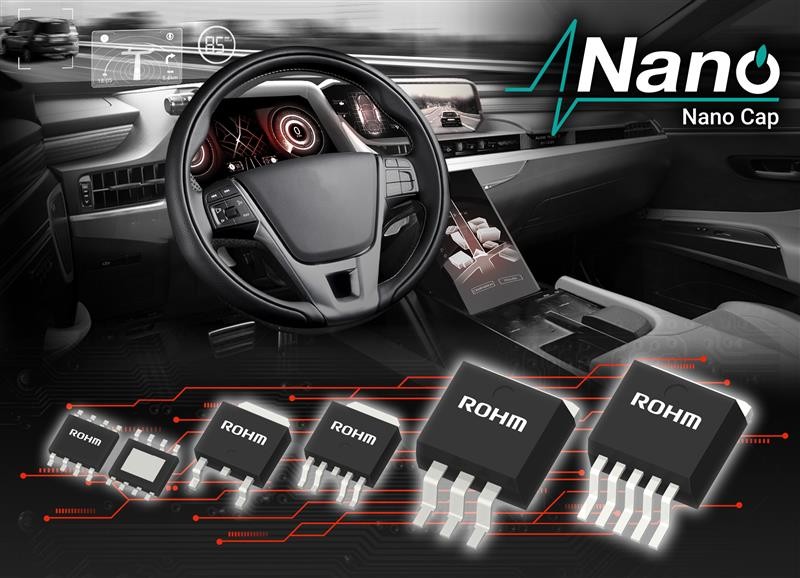
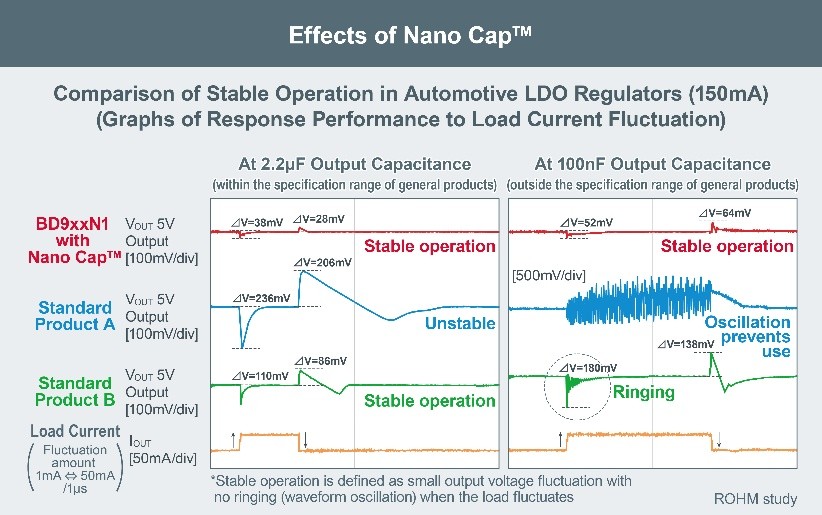
In recent years, electronic devices have been developing towards miniaturization and high density. In order to further save space and improve design flexibility, power circuits urgently need a power IC that can operate stably even with small capacity capacitors. However, there are still technical difficulties in achieving stable operation with output capacitors below 1 µ F. In response to this issue, ROHM will launch the Nano Cap in 2022, which is equipped with its own ultra stable control technology ™” The LDO regulator "BD9xxN1 series (output current 150mA)". This series of products has received high praise from customers for its high performance and stable operation with only 100nF of output capacitor borrowed. Currently, it has accumulated rich practical application performance. The newly developed "BD9xxN5 series" supports applications that require higher currents and can further assist in solving issues related to output capacitors in power supply design.
This series of products is a current expansion model of the highly acclaimed "BD9xxN1 series" (output current 150mA), with an output current increased to 500mA, which is more than three times that of previous models. It is suitable for applications that require larger currents and has a wider range of applications. In addition, this series of products also adopts the "Nano Cap ™” Technically, it has been proven that even under the condition of only 470nF (Typ.) output capacitance, the output voltage fluctuation can be suppressed within a range of about 250mV (when the load current fluctuates by 1mA ⇔ 500mA/1 μ s), and the operation is very stable. In addition to conventional small MLCCs (stacked ceramic capacitors) with a few μ F and large capacity electrolytic capacitors, this series of products can also be compatible with ultra small MLCCs with capacitance values below 1 µ F and 0603M size (0.6mm × 0.3mm) that were previously difficult to ensure stability. This not only helps to achieve miniaturization of circuits and circuit boards, but also improves the flexibility of component selection.
This series of products has been put into mass production with a monthly output of 300000 units starting from October 2025 (sample price of 300 yen per unit, excluding tax). The new product has started to be sold through e-commerce. In addition, simulation models for verification can also be obtained from the ROHM official website - the high-precision SPICE model "ROHM Real Model * 3" (SPICE models: BD900N5xxx-C, BD933N5xxxx-C, BD950N5xxxx-C).
In the future, ROHM will be equipped with Nano Cap through further expansion ™ The LDO series product group of technology contributes to the miniaturization, performance, and reliability improvement of electronic devices.
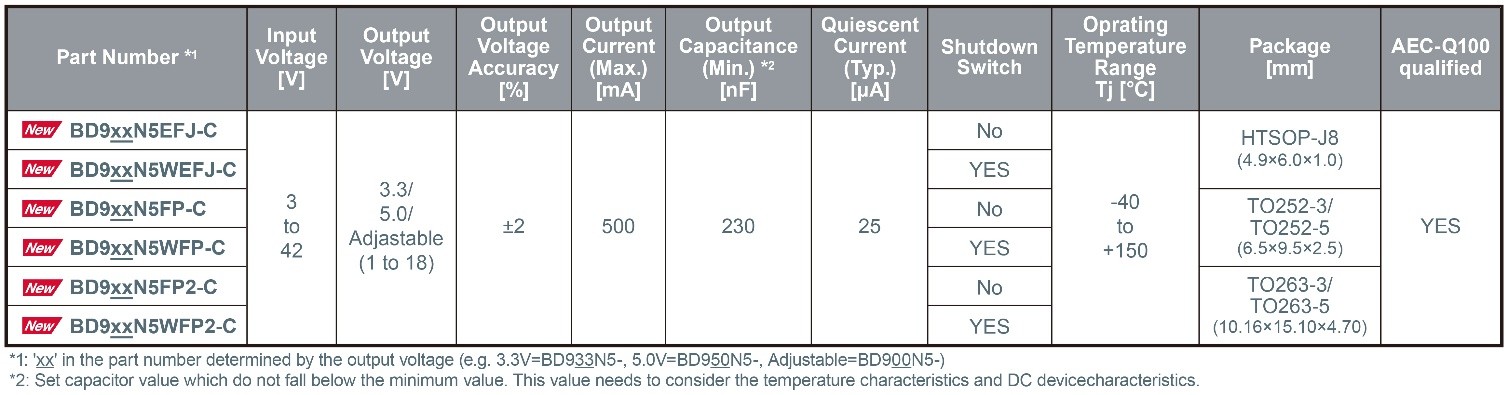
Product lineup
<Application Example>
Vehicle mounted equipment:
Power supply related to powertrain systems such as fuel injection system (FI) and tire pressure monitoring system (TPMS)
Power supply related to body control module (BCM) and other body systems
Power supply related to information and entertainment systems such as dashboard and head up display (HUD)
Industrial equipment:
Power supply for programmable logic controllers (PLCs), remote terminal units (RTUs), industrial gateways, and other controllers
High precision LDO for simulating loads and sensors such as temperature, pressure, and flow rate
Power supply for building automation, disaster prevention, access control and other monitoring controllers
Standby power supply for human-machine interface (HMI) and display panel, etc
Consumer Electronics:
Power supply for control circuit boards of refrigerators, dishwashers, air conditioners, and other equipment
Power supply for residential equipment such as thermostats and doorbells
Power supply for continuous power supply of home security systems and network equipment
<About Nano Cap ™>
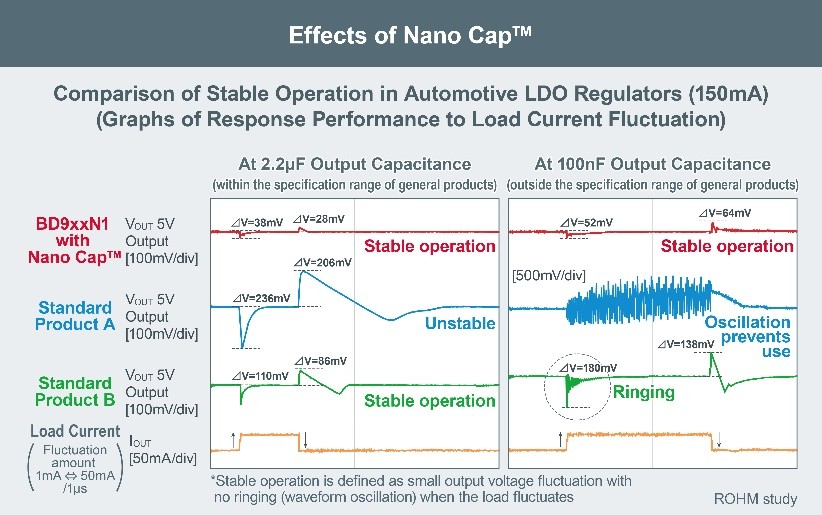
Nano Cap ™ It refers to the use of ROHM's vertically integrated production system to achieve ultra stable control technology by integrating the advantages of three simulation technologies: circuit design, layout, and process. By utilizing this stable control technology, the stable operation issues related to capacitors in analog circuits can be eliminated, which helps to shorten the design cycle of various application products in fields such as automobiles, industrial equipment, and consumer electronics.
Special page: Roma "Nano" power technology for energy conservation and miniaturization
ROHM's production and manufacturing: "Nano power technology"
Video: Nano Cap Ultra Stable Control Technology ™
Nano Cap ™ It is a trademark or registered trademark of ROHM Co., Ltd.
<Terminology Explanation>
*1) Primary
In power ICs, from the perspective of batteries and other power sources, the one responsible for the first level conversion is called "Primary", and the one responsible for the subsequent second level conversion is called "Secondary".
*2) LDO regulator (Low Drop Out regulator/Low Saturation regulator)
A power IC that can convert voltage from direct current (DC) to direct current. Its input and output voltage difference is small, and it belongs to a linear regulator (input and output voltage are linearly operated). Compared with DC-DC converter ICs (switching regulators), it has the characteristics of simple circuit structure and less noise.
*3) ROHM Real Model
The high-precision SPICE model utilizes ROHM's proprietary model-based technology to faithfully reproduce the electrical and temperature characteristics of the actual IC, thereby achieving complete consistency between the actual and simulated values of the IC. Through practical and reliable verification, problems such as rework after product trial production can be prevented, which helps to improve the development efficiency of application products.