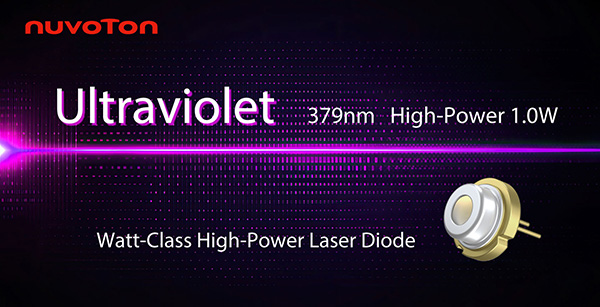
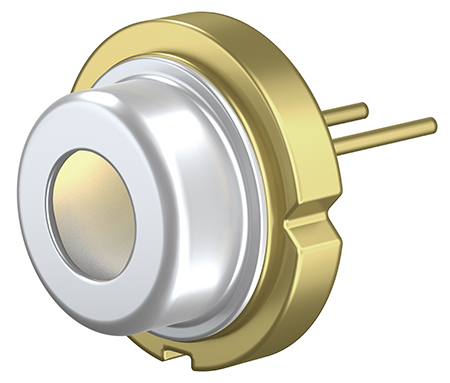
Nuvoton Technology Corporation Japan (NTCJ) announced on January 20th that it has started mass production of its high-power ultraviolet semiconductor laser (379 nm, 1.0 W). This product adopts a CAN package (TO-9) with a diameter of 9.0 millimeters, which can achieve industry-leading (*) optical power output. Through NTCJ's proprietary device structure and advanced high heat dissipation packaging technology, this product achieves three characteristics of UV semiconductor lasers that were difficult to break through in the past: short wavelength, high power, and long lifespan. This helps to improve the graphic precision and production efficiency of advanced semiconductor packaging maskless lithography.
(*) As of January 16, 2026, research on semiconductor lasers with a wavelength of 379 nm, TO-9 CAN package, and continuous wave (CW) operation at 25 ° C shell temperature (Tc) based on NTCJ.
With the development of artificial intelligence (AI) driving the demand for information processing capabilities, the requirements for semiconductor performance are constantly increasing compared to the past. On the other hand, as the miniaturization of transistors approaches their physical and economic limits, semiconductor backend packaging technology and advanced semiconductor packaging technology (integrated solutions through parallel arrangement or vertical stacking of multiple semiconductor chips) are attracting attention.
The evolution of these packaging technologies cannot be separated from the support of maskless exposure technology. As one of the key light sources in maskless lithography technology, semiconductor lasers are facing a growing demand for shorter wavelengths (close to i-line 365 nm) and higher output power to achieve finer lines and improve equipment capacity. To meet these requirements, NTCJ has developed and commercialized a UV semiconductor laser with a wavelength of 379 nm and an output power of 1.0 W, based on over 40 years of experience in laser design and manufacturing.
Ultraviolet semiconductor lasers typically suffer from significant heat generation issues due to low photoelectric conversion efficiency (WPE), as well as a tendency for device degradation caused by ultraviolet light, making it difficult to achieve stable operation at high output levels above 1.0 W. To address this issue, NTCJ has adopted a dual approach, focusing on both "improving the device structure of WPE" and "high thermal conductivity packaging technology for effective heat dissipation", and successfully developed a product that combines short wavelength, high power, and long lifespan: a 1.0 W ultraviolet (379 nm) laser diode. This helps to extend the lifespan of ultraviolet optical devices.
As a new member of NTCJ's "Semiconductor Laser based Mercury Lamp Replacement Products" series, this product provides customers with a new option.
NTCJ will showcase detailed information about this new product at the SPIE Photonics West 2026 exhibition in San Francisco, USA, and the OPIE'26 exhibition in Yokohama, Japan. NTCJ sincerely looks forward to your visit.