Surface mount devices use sturdy nanocrystalline magnetic cores and over molded reinforcement structures, providing reliable performance in harsh environments
Recently, Vishay Intertechnology, Inc. (NYSE stock code: VSH) announced the launch of a new aerospace grade surface mount common mode choke, SGCM05339, suitable for electromagnetic interference (EMI) filtering and noise suppression in harsh aerospace applications.
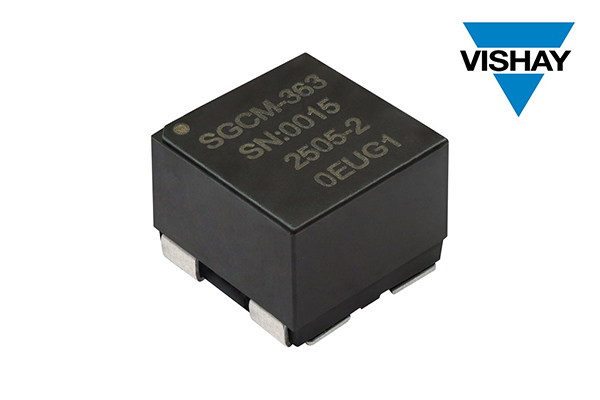
Vishay customized magnetic core SGCM05339 is an ideal choice for GaN and SiC switch applications, where the waveform may exhibit sharp edges, leading to electromagnetic radiation interference. Common mode chokes can also be used in low current vertical power supplies, DC/DC converters for distributed power systems, and power converters for solar panels.
To cope with the harsh conditions of the application environment, this self shielding device adopts a compact and sturdy nanocrystalline magnetic core and an over molded reinforcement structure. SGCM05339 provides spread spectrum high impedance, supports a temperature rise current of up to 14.43 A, and operates continuously at temperatures ranging from -55 ° C to+130 ° C.
The recently released device meets multiple screening criteria of ASTM-E595 standard, including MIL-PRF-27、Grade 5、Product Level T、Temperature Class S、MIL-STD-981 Family-4、Class S And EEE-INST-002. SGCM05339 has a withstand voltage of 1000 VRMS and an insulation resistance of 500 VDC. It can be customized according to the number of turns, wire gauge, etc., to meet the requirements of specific applications.
Device specification table:
Product Number | SGCM05339 |
Sense value | 320 µH~10 400 µH |
Common mode impedance (typical value) | 540 Ω~3600 Ω |
Winding DC resistance (maximum value) | 0.0029 Ω~0.1318 Ω |
Temperature rise current (typical value) (¹) | 2.02 A~14.43 A |
Peak impedance frequency | 2.06 Hz~31.74 Hz |
Leakage sensation (maximum value) | 0.35 µH~7.75 µH |
(1) DC current of series winding when Δ T rises by about 30 ° C (A)
The new aerospace grade common mode choke coil can now provide samples and has achieved mass production, with a supply cycle of 8 to 12 weeks.